


This guide brings together the analytical framework Nobilys applies in its advisory work, from the initial assessment of an AI initiative through to portfolio-level governance.
This page is not indexed. You are accessing it because you have engaged with Nobilys.
The concepts that matter to leaders who invest in artificial intelligence.
Facts before narratives · Impact before technology · Evidence before deployment · Governance before industrialization
Start reading
01 What AI is, and what it is not.
Sufficient technical clarity to ask the right business questions.
In this section
how AI works → what it actually sees → its major families → what it can contribute to the organisation..
A- AI is "a prediction machine"
Behind demand forecasting, fraud detection, maintenance alerts or language models, a single mechanism is repeated: estimating a result from existing data.
Depending on the case, this result can be a word, a class, a probability, an anomaly, or a recommendation. The questions are different, but the logic remains the same: to reduce a degree of uncertainty based on observable signals.
AI predicts, classifies, scores, or generates. It does not decide on its own the value created.
-
B- AI learns from data, not from reality
A model never sees reality itself.
He sees the recorded trace of what the company measures, stores, and makes available.
This has a major consequence: more data does not automatically mean more intelligence.
What matters is the quality of the data used:
their relevance, reliability, representativeness, freshness, accessibility and lawful use.
A company can be rich in data and poor in truly usable data.
-
C- AI is not a strategy
AI does not replace either a clear business diagnosis or a demonstration of value.
A model may be efficient, but if no one acts on its result, if the process does not change, or if a simpler solution suffices, the value remains theoretical.
The right question to ask is:
What decision or task can we improve, and is AI really the best option?
D- The major families of AI
Not all forms of AI do the same thing.
The choice of technology depends on the type of business need to be addressed, not on the popularity of the tool.
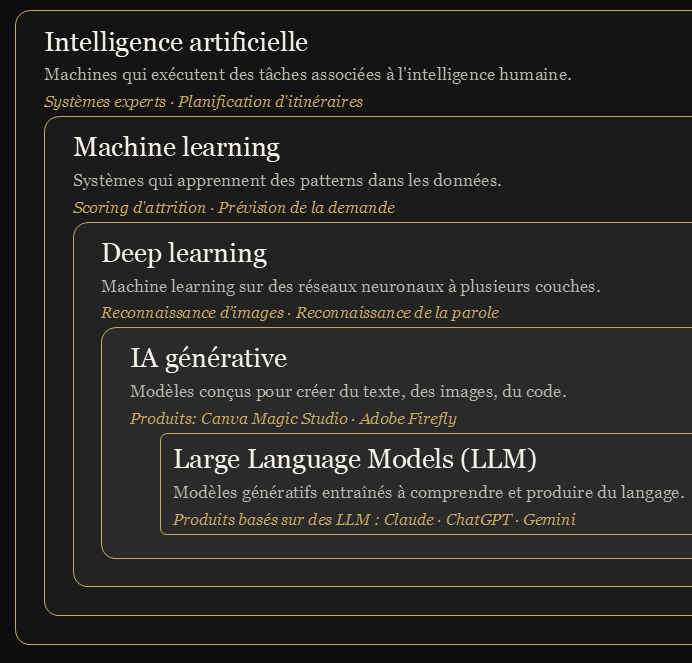
Artificial intelligence encompasses several technology families designed for different types of tasks.
Machine learning identifies patterns in data to predict, classify or detect. This is the case, for example, with a churn model, a demand forecast, or a fraud detection system.
Deep Learning, which relies on neural networks, is particularly well suited to complex data such as images, audio and language.
Generative AI is designed to produce or transform content: text, images, audio, video or code.
Large Language Models (LLMs) are generative models trained to understand and produce language.
The diagram provides a simplified view of the modern AI ecosystem.
It is also important to distinguish models from products.
ChatGPT, Claude, Gemini and Copilot are not AI categories. They are products built around models, often combined with additional components, data, interfaces and usage rules.
E-Signal. Content. Action.
Beyond technology families, AI can contribute in three main ways:
It can produce a signal, create or transform content, or help execute an action.
These three forms can be combined in the same process.
End of section
What AI is, and what it is not
02 An investment decision.
Technology comes after the decision to improve and the value to prove.
In this section
Which decision to improve? → which capability to use? → how much autonomy to grant? → which decisions are genuinely suited to AI?
A- Two questions before discussing technology
B- Choose the appropriate capacity
Each situation calls for the most appropriate capability, and that is not always AI.
Below are some of the capabilities that may fit different situations.
01
ANALYTICS
To understand what is happening.
Display, aggregate, compare, explain.
BI · dashboards · reporting
02
RULES
Apply a known and stable logic
If A and B are true, then execute C.
Business rules · fixed thresholds
03
PREDICTIVE AI
Reducing uncertainty
Predict, classify, detect, score.
Machine Learning
04
GENERATIVE AI
Interpreting or producing content
Summarize, extract, reformulate, generate.
LLM · multimodal models
A process improvement, a business rule, automation - or even deciding not to intervene - can sometimes create the same value more simply.
Choose the simplest capability that achieves the desired result.
C- Choosing the level of autonomy granted to the system
01
HUMAN-LED
The system provides information.
The humans decides and acts.
Decision: human
Action: human
Responsibility: human
02
AI-ASSISTED
AI recommends, scores, or proposes.
The human validates before action.
Final decision: human
Action: Human or approved workflow
Responsibility: human
03
AUTOMATED
Predefined steps are executed without case-by-case human validation.
Decision: rules or predefined logic
Action: system
Human role: monitoring and exceptions
04
AI AGENT
The system can select and execute different steps to achieve a goal within a defined framework.
Choice of steps: system
Action: system
Human role: objectives, permissions, safeguards & control
The level of autonomy must remain compatible with the cost of error,
its reversibility and accountability for the decision.
Choose the lowest level of autonomy that reliably captures the value.
Greater autonomy is not a sign of maturity. It is a design choice.
D- Not all decisions are equally suited to AI
STRATEGIC
Rare · Unique ·
Highly contextual
AI can primarily inform judgment.
TACTICAL
Repeatable · Data-rich ·
Significant value
Often suitable for AI assistance.
OPERATIONAL
Frequent · Repeatable ·
Measurable
Often well suited to AI or automation.
MICRO-DECISION
Individualised · Very high volume · Repeated at scale
Often particularly well-suited to AI.
The more repeatable, observable and measurable a decision is, the stronger the potential fit with AI.
End of section
An investment decision.
03 From output to result
A model that produces no decision change produces no value
In this section
how an AI output becomes a decision → why it must demonstrate incremental value over the existing approach → how errors translate into economic impact → what conditions allow value to be captured.
A- AI produces outputs. Organisations create outcomes.
Data
AI Output
Forecast · Probability · Score · Alert
Generated content
Human or system evaluation
Decision
Action
Economic outcome
Margin · Cash · Costs · Quality · Service · Risk
A model can produce a highly accurate forecast, a relevant alert or an excellent summary. None of these outputs creates economic value by itself.
Between the output and the final outcome are several steps that the model alone cannot guarantee: interpreting the result, deciding whether it justifies action, choosing that action, executing it and taking accountability for the outcome.
What the model cannot do by itself
- define the business objective;
- determine whether its output matters;
- choose the acceptable cost of error;
- ensure that someone acts;
- carry accountability for the outcome.
AI produces outputs.
Organisation create outcomes.
B- Three conditions for creating value
A model can be accurate and still destroy value.
Technology identifies the opportunity.
The organisation captures the value.
C- A simple way to reason about capturable value
Value at stake
× Frequency
× Actionable share
× Intervention effectiveness
- Cost of action
- Cost of errors
- Implementation cost
=
Capturable Value
End of section
From output to result
04 How to Identify a Strong AI Initiative
Three dimensions, one decision grid.
In this section
Frame an assessable initiative → assess it across three dimensions → identify the main execution risks → position it within the matrix → verify the assumptions before deciding
A- Turn an idea into an assessable initiative
B- Assess the initiative across three dimensions
C- Why AI initiatives fail before the first model
When AI initiatives fail, the cause is rarely the model alone.
Strategy, foundations, and ownership often determine the outcome.
AI before business diagnosis
The answer came before the question.
Visibility over value
The initiative impresses. The economic question is never asked.
Data assumed, not verified.
Availability, history, quality, definitions and ownership are taken for granted
Technical proof only
Decision impact, actionability and net value are not measured.
Decision process unchanged
The decision rules and accountabilities remain untouched. Without change management, the model changes nothing.
No end-to-end owner
Data, IT, the vendor and the business each own one component. Nobody owns the result.
D- Position the initiative within the Nobilys prioritisation matrix
Impact and feasibility determine the initial position.
Execution risk determines whether that position is actionable.
This is a preliminary assessment.
Priority initiatives must be verified against real data before investment approval.
E- Verify before deciding
01
FRAME
Economic priorities · initiatives · context · data assets
02
ASSESS
Expected value · feasibility · execution risk
03
VERIFY
Actual extracts · historical data · missing data · consistency of definitions · actual frequency of events
A matrix developed in a meeting room still represents the organisation’s assumptions.
Testing the assumptions against real data turns them into decision evidence.
This verification can correct assumptions in both directions:
- An initiative initially considered straightforward may prove unrealistic because the historical record is inadequate;
- Another, initially viewed as difficult, may prove feasible because the data is already.
4 final decisions
DEFER
The case is relevant, but not a priority at this stage.
An explicit decision,
motivated and dated.
DISCARD
Impact too low · disproportionate risk · or a simpler solution exists.
Automation, process improvement or deciding not to intervene may sometimes create more value, faster and with less risk.
Discarding an AI initiative is not a failure.
It's a resource allocation decision.
End of section
How to identify a strong initiative
05
Governing AI as a Portfolio of Investments
AI governance is not an IT question. It is a capital allocation question.
In this section
Make commitments visible → preserve the option to stop → allocate scarce resources → clarify who owns, monitors and can stop each initiative → govern unmanaged AI use
A- What small commitments can hide
Taken separately
- Copilot licences or other AI assistants;
- subscriptions to specialised tools;
- pilots delivered by external providers;
- internal developments;
- cloud and API consumption;
- data and IT team time;
- experiments funded by individual functions.
Each commitment may remain below normal approval thresholds.
Taken together
They consume real:
Budget · IT Capacity · Data · Business Time ·
Management attention ·
Change capacity · Risk
What appears marginal initiative by initiative can become a material investment at enterprise level.
For each active initiative, management should be able to identify:
| Business owner | Who owns the outcome? |
|---|---|
| Value Hypothesis | What improvement are we expecting? |
| Evidence available | What have we actually demonstrated? |
| Cumulative commitment | How much have we already committed? |
| Key prerequisite | What's still missing? |
| Next decision date | When will we reassess the initiative? |
| Stop conditions | What would make us stop? |
B- Preserve the option to stop
An AI initiative can offer a rare investment advantage:
it can often be stopped early, before significant resources have been committed
Unlike many physical investments, AI initiatives can often be tested, observed and reassessed before further capital and capacity are committed.
But this option only truly exists if the organization defines, before starting:
- the evidence required;
- the maximum commitment before that evidence is available;
- the next decision point;
- the criteria for continuing, correcting or stopping.
The option to stop at low cost loses its value if stop conditions are only defined after the investment has been made.
Before starting, be able to answer four questions:
What evidence do we need? · How much are we prepared to commit? ·
When will we decide? · What would make us stop?
C- Allocating resources over time
ONCE THE PORTFOLIO IS ESTABLISHED,
HOW SHOULD RESOURCES MOVE BETWEEN INITIATIVES?
THE PURPOSE IS NOT TO RUN MORE AI INITIATIVES. IT IS TO CONCENTRATE RESOURCES ON THE FEW THAT MERIT PROOF, CONTINUATION AND SCALE.
D- Who owns, monitors and can stop the initiative?
An initiative does not become governed simply because a committee has approved it.
It is governed when responsibilities, controls and the authority to stop are explicit.
01
BUSINESS
OWNER
Owns the decision, the use case and the value created.
02
TECHNICAL
OWNER
Ensures reliable operation, integration and technical performance.
03
DATA / RISK / LEGAL as applicable
Provide oversight on data quality, security, compliance and required controls.
04
SPONSOR / MANAGEMENT
Allocates the investment, accepts the level of risk and can decide to continue, suspend or stop.
Without a business owner, monitoring and the ability to stop the system,
it should not be deployed widely.
E-Governed AI vs Shadow AI
A few figures give an idea of the reality in business
Source: LayerX, Enterprise AI and SaaS Data Security Report 2025.
45%
of employees use GenAI at work.
77%
of GenAI users paste company data into prompts.
82%
of sensitive pastes come from unmanaged accounts
Governance is not only about officially approved initiatives.
It must also address the AI use that emerges informally across the organisation.
The real choice is rarely “AI or no AI”.
It is governed use or unmanaged use.
The approved route must be simple and useful enough
that bypassing it does not become the easier option.
End of section
Governing AI as a Portfolio of Investments
06 AI Business Applications to Create Value
Documented and concrete use cases.
In this section
See where AI can create value → understand which decision is being improved → identify AI’s contribution → recognise the conditions for success
A use case is not valuable because it uses advanced technology.
It matters when it improves a decision or process in a measurable way that justifies its cost and risk.
The examples below illustrate different value-creation logics.
They are neither exhaustive nor universal recommendations.
The models mentioned below are those selected or tested in these specific examples. They are not universal recommendations: the right approach depends on the data, the baseline, the cost of errors and the economics of each situation.
CUSTOMER RETENTION / CHURN RISK
The case
An e-commerce business wanted to reduce losses from customer disengagement without multiplying unnecessary retention actions.
Decision to improve
Which customers should receive priority commercial intervention before they become unrecoverable?
AI Contribution
Use customer characteristics and behaviour to estimate churn probability and prioritise customers by risk.
AI Approach
Predictive AI - supervised classification
Model selected in the example
Gradient Boosting, after comparison with a business rule, a logistic regression and a Random Forest.
The choice was made based on economic performance, not on technical sophistication.
Value sought
Focus retention effort more effectively, reduce unnecessary actions and protect revenue or margin.
Key Consideration
Predicting churn does not solve churn. Value depends on the organisation’s ability to act effectively on the customers identified.
Cross-selling
The case
A spare-parts distributor had 24 months of transaction history and wanted to identify relevant complementary offers for individual customers rather than make the same recommendations to everyone.
Decision to improve
Which complementary offers should be recommended to which customers to generate profitable additional margin?
AI Contribution
Identify product categories that are frequently purchased together and generate targeted recommendation opportunities.
AI Approach
Unsupervised learning - purchase-pattern discovery.
Model selected in the example
Association rules, compared with a simple baseline recommending the most profitable categories globally.
Value sought
Increase margin through more targeted commercial actions.
Key Consideration
An identified opportunity is not a sale. Value depends on actual conversion, margin and the cost of commercial action.
Demand forecast
The case
A European distributor operating across multiple sites and products relied on quarterly moving averages for replenishment. Seasonality was being smoothed out, contributing to stockouts on some products and excess inventory on others.
Decision to improve
How much should be forecast and replenished by product, site and period to balance service level and inventory?
AI Contribution
Produce forecasts that better capture historical patterns, trends and seasonality.
AI Approach
Predictive modelling - forecasting / regression.
Value sought
Reduce excess inventory, release working capital and limit margin loss from stockouts.
Key Consideration
A better forecast creates value only if it changes replenishment and planning decisions.
Risk of supplier delay / continuity of supply
The case
In an exercise involving air freight flows, the challenge was to identify shipments at risk of delay early enough to determine which ones would benefit from preventative intervention. This is a methodological demonstration, not a real-world customer case study.
Decision to improve
Which flows warrant preventive action before the delay becomes costly?
AI Contribution
Estimate the probability of delay and focus interventions on the situations where the economics justify action.
AI Approach
Predictive scoring - classification.
Model selected in the example
Logistic Regression, after comparison with a global baseline, a simple transport-structure rule, Random Forest and Gradient Boosting.
It delivered the best economic performance and remained fully explainable. The more complex models added no economic gain.
Value sought
Reduce the cost of delays and emergency action without intervening on every shipment.
Key Consideration
The most sophisticated model is not necessarily the most useful. In this example, the simpler statistical approach produced the better economic decision.
Predictive maintenance
The case
In an industrial environment, an unplanned breakdown can lead to production stoppages, urgent repairs, emergency parts shipments, overtime, and customer delays. The key question is whether machine signals allow for intervention before the breakdown occurs. This, too, serves as a methodological demonstration.
Decision to improve
Which machines should be serviced before a breakdown occurs?
AI Contribution
Combine signals from equipment to estimate their risk of failure and prioritize preventive interventions.
AI Approach
Predictive AI - supervised classification on sensor data.
Model selected in the example
Gradient Boosting, after comparison with logistic regression and Random Forest.
But the essential point is not just the model: the decision threshold was determined economically by taking into account the cost of a missed failure and the cost of a false alarm.
Value sought
Reduce unplanned downtime while avoiding excessive preventative maintenance.
Key Consideration
The best threshold is not the one that detects the maximum number of failures. It is the one that minimizes the total economic cost of the errors.
Quality defect detection
The case
A manufacturing example uses product images to distinguish compliant parts from parts showing different types of defects. The exercise is based on the MVTec AD dataset; it is not a customer use case.
Decision to improve
Which products should be accepted, rejected, or sent for further inspection?
AI Contribution
onvert images into measurable features and classify products according to conformity.
AI Approach
Image analysis + supervised machine learning.
Model selected in the example
Random Forest, after comparison with Logistic Regression and Gradient Boosting.
Random Forest was retained because it produced no false rejects in the test.
Gradient Boosting performed extremely well but carried a higher overfitting risk on the small dataset.
Value sought
Reduce missed defects and manual inspection while avoiding unnecessary rejection of compliant products.
Key Consideration
Model performance cannot be separated from image-capture conditions, sample size and the economic cost of each type of error.
AI agentic / case processing
The case
An investment fund receives approximately 600 applications per year in mixed formats. A large majority are eliminated during the screening process, but the team dedicates a significant portion of its time to reading, structuring, and preparing the information before even exercising its investor judgment.
Decision/process to improve
How can preparation time be reduced without delegating the investment decision to AI?
AI Contribution
Read incoming documents, extract key information, score dossiers against defined criteria, prepare a structured first assessment and make past decisions searchable.
AI Approach
Generative AI agentic architecture business rules and tools.
Architecture used in the example
Document intake and extraction → scoring against defined criteria → proposal generation → searchable memory.
Value sought
Reduce preparation time and free more team capacity for analysis, challenge and human judgement.
Key Consideration
The agent prepares. The team decides.
Other use cases

Finance / Closing
FINANCIAL CLOSE
High volumes of journal entries and repetitive controls → focus review on unusual entries and anomalies → anomaly detection / statistical rules.

Customer Service
CUSTOMER SERVICE
High volumes of heterogeneous requests → determine priority, category or the response to prepare → classification / generative AI.

Pricing
PRICING
Frequent pricing decisions under constraints → inform or optimise price levels → predictive models / optimisation. A rule-based or analytical approach may sometimes be sufficient.

Fraud detection
FRAUD DETECTION
High transaction volumes with a small number of atypical events → decide which transactions require investigation → supervised classification / anomaly detection.
End of section
AI Business Applications to Create Value