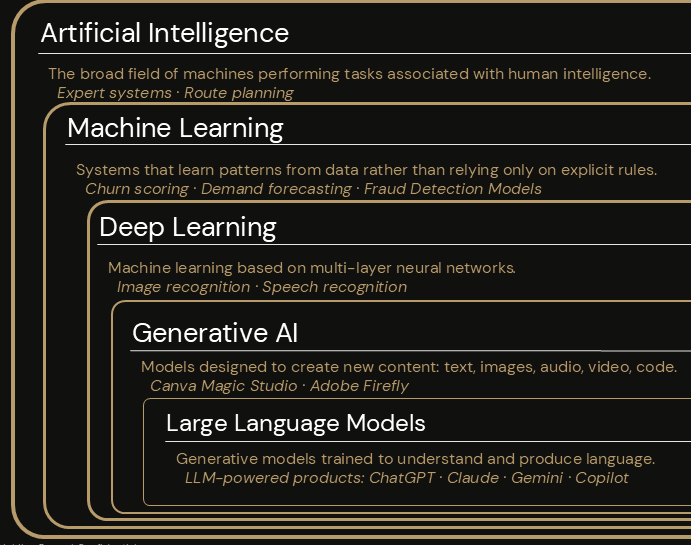
The nature of the business question is often the best first guide to the technology worth considering.
Artificial intelligence, machine learning, deep learning, generative AI and large language models are often discussed as though they were interchangeable technologies, even though they describe different capabilities and approaches.
The distinctions matter because they help prevent common investment errors, such as introducing a complex model where a business rule would do the job, asking an LLM to solve a forecasting problem, or treating technical sophistication as evidence of value.
For an executive, the useful level of understanding lies in knowing which family of methods fits which type of problem, what data it requires and which constraints need to be reflected in the decision. Detailed knowledge of each algorithm is rarely necessary.
The starting question is consistent across all of these technologies
Which decisions are we trying to improve, and what uncertainty is currently preventing us from making them well?
I- Rules, optimisation and the boundary of AI
Before comparing the main families of AI, executives benefit from recognising where conventional rules and optimisation already solve the problem well. A significant share of what is marketed under the AI label relies on older, well-established methods that require no learning model at all.
Coded business logic is the most obvious example. An order can be blocked automatically when it exceeds a customer's credit limit, uses a price that differs from the current contract, or contains a product reference that has not been approved for that customer. A compliance engine can check a case against regulatory criteria, apply the same rules consistently and provide a precise audit trail for every decision. The logic is defined in advance by experts and configured in the relevant business systems; it does not learn from historical data.
Mathematical optimisation is a second, subtler case. A logistics company planning delivery routes may seek to minimise mileage or total cost while respecting vehicle capacity, customer delivery windows, driver availability and driving-time limits. The system explores a very large number of possible combinations and identifies the one that best meets the objective within the stated constraints. Operations research is sometimes placed within the historical family tree of AI because it solves search problems that would otherwise demand considerable human expertise. Its value, however, does not depend on learning from data: the system calculates the best answer to a fully specified problem.
An industrial allocation decision illustrates the power of this approach. Suppose a company has only 70% of the capacity required to fulfil all confirmed orders in a given week. It must allocate scarce capacity across customers, production sites and transport modes while considering contribution margin, contractual commitments, the criticality of the product to the customer, logistics cost, the availability of an alternative production site and the commercial risk associated with delay. An optimisation method can identify the allocation that best meets the chosen objective across all of those constraints without being trained on historical data.
Machine learning enters when some of the inputs are uncertain. Expected demand for the following week or the probability of a supplier delay cannot be known in advance, but they can be estimated from historical data and then fed into the allocation problem.
A single decision can therefore combine three different types of solution. Business rules protect contractual constraints, optimisation calculates the trade-off, and machine learning reduces uncertainty in selected inputs. Only the third component involves a model that learns from data in the sense most commonly associated with AI today.
The distinction has direct investment implications. When rules are known, stable and sufficient, a deterministic system will usually be easier to explain, maintain and control. When the objective and constraints can be stated explicitly, optimisation deserves consideration before a predictive model is introduced. Machine learning becomes economically relevant when a genuine uncertainty can be reduced through data and when that reduction can improve a decision.
Artificial intelligence is not a single technology.
The field brings together several families of methods, ranging from systems based on explicit logic and search to models that learn, predict or generate from data.
The following sections focus on the main families that executives are most likely to encounter in business.
A- Machine learning: using data to reduce uncertainty
Machine learning becomes relevant when historical data contains patterns that can improve a prediction, classification or detection task.
The model learns from past examples and applies the relationships it has identified to new situations.
The following use cases illustrate how that principle translates into business decisions.
B- Deep learning: working with more complex data
Deep learning is part of machine learning and uses neural networks with multiple layers. It is particularly relevant when useful information is difficult to represent as conventional table columns, as is often the case with images, text, sound, video and certain industrial signals. Three examples show what this capability can change in an industrial setting.
C- Generative AI: creating and transforming content
Generative AI produces new content based on structures learned from large volumes of data. It can generate text, images, audio, video, code and synthetic data.
Its economics often differ from those of predictive models because a significant share of the value comes from reducing the time required to create, transform or prepare content.
The following examples illustrate the range of applications.
D- Large language models (LLMs): working with language and documents
Large language models, or LLMs, are a family of generative models designed to process and produce language.
Products such as ChatGPT, Claude, Gemini and Copilot are built around such models and add interfaces, tools, security mechanisms and other services.
For businesses, their relevance extends well beyond drafting text.
III- Matching the technology to the decision
The nature of the business question provides a useful first orientation towards the approaches worth considering.
Cette grille fournit une première orientation. Le choix final dépend de la qualité des données, de la baseline existante, de la fréquence de la décision, du coût des erreurs, de la capacité d’action, des contraintes d’intégration et de la valeur économique attendue.
IV- La hiérarchie technologique ne détermine pas la valeur
This framework provides an initial direction. The final choice also depends on data quality, the existing baseline, decision frequency, the cost of error, the organisation's ability to act, integration constraints and expected economic value.
V- Questions to ask before discussing the model
Technical discussions become more useful once the economic and operational foundations are clear.
A- Which decision are we trying to improve?
The initiative should be linked to a concrete decision or execution step: how much to produce, what to stock, where to intervene, which case to review, which customer to contact, what to accept, what to prioritise, when to escalate or how to allocate a scarce resource.
This clarity makes it possible to measure the system's contribution.
B- What uncertainty makes the decision difficult?
A stable rule may be sufficient when the answer can be determined explicitly.
Machine learning becomes more relevant when several variables interact and historical data contains information that can improve the decision.
C- What data is actually available?
Data volume is only part of the issue.
History, quality, granularity, consistency and the link to the target decision matter more.
In predictive maintenance, millions of sensor readings have limited value if the business does not have a reliable history of failures and interventions.
D- What is the current baseline?
The comparison should be made against the method used today.
For demand forecasting, the baseline may be the planners' forecast. For anomaly detection, it may be a set of rules. For document summarisation, it may be the time currently required by an analyst.
A more complex model should demonstrate a sufficient improvement over that reference point.
E- What does an error cost?
Average accuracy can hide very different economic consequences.
A false positive in a commercial alert may trigger an unnecessary phone call. A false negative in critical quality control can cause a product recall, disruption at a customer's plant or contractual exposure.
The threshold should reflect the cost of the different types of error as well as the cost of the actions triggered by the system.
F- Can the organisation act on the signal?
A forecast or score creates little value when the operating process leaves no room to act.
A model that predicts a supplier delay three days before delivery has limited usefulness if no alternative transport, production-plan change, back-up supplier or available stock can alter the outcome.
The ability to act belongs in the business case from the outset.
G-Does the additional value justify the complexity?
A higher-performing model may require more data, integration, monitoring, internal skills and governance.
The economic comparison should include those costs together with error and adoption costs. Technical improvement becomes attractive when the resulting decision creates net value beyond the additional burden of the solution.
The main families of artificial intelligence address different types of problems. Rules handle many deterministic decisions efficiently, optimisation supports trade-offs under constraints, machine learning improves selected predictions using historical data, deep learning works with complex data, and generative models create or transform content.
In practice, several approaches often operate within the same process. An allocation system may use a machine-learning demand forecast before optimising capacity. Customer Service may combine contractual rules, anomaly detection and text analysis. A maintenance solution may combine sensors, a predictive model and safety rules.
For executives, the useful understanding lies in connecting each technology to an identifiable decision, a baseline and a credible mechanism of value creation. Additional sophistication is justified when it improves the decision enough to offset the extra cost of data, integration, maintenance, adoption and governance.
VII- Appendix: a concise guide to key AI models and architectures
The terminology used around artificial intelligence does not describe a single level of technology. Some terms refer to computational methods, others to learning models, neural-network architectures, techniques for adapting a model, or complete systems that combine several components.
This appendix groups the main terms by their nature so that concepts operating at different levels are easier to distinguish.
A- Rules, optimisation and control
This first group covers methods that may sit within the historical or broader field of artificial intelligence, while not necessarily learning from historical data.
B- Classical machine-learning models
These models learn relationships from historical data. They are particularly well suited to structured information found in ERP and CRM systems, financial platforms, customer databases and industrial systems.
C- Deep-learning architectures
Deep learning sits within machine learning and relies on neural networks capable of learning complex representations, particularly for images, text, audio, video and certain industrial signals.
The terms in this section mainly describe architectures, meaning the way the neural network is organised.
Generative models learn the structure of data in order to produce new content or plausible new observations.
LLMs are very large deep-learning models, today based predominantly on Transformer architectures.
F- Techniques for using or adapting a model
RAG and fine-tuning are often discussed alongside model families, although they describe different ways of using or adapting an existing model.
G- How models are made available
H- Agents and agentic systems
I- Summary table: models, architectures, techniques and systems
The definitions above cover concepts of different kinds. Some terms refer to models that learn from data, others to architectures used to build those models, techniques used to adapt or enrich them, or systems that combine several components.
The table below places each term in the appropriate category and shows whether learning from data is part of the concept.
Reading note.
This classification is intended as a practical guide rather than an exhaustive academic taxonomy. Real systems often combine several categories. An agent, for example, may use an LLM, document retrieval, business rules and an optimisation engine within the same process.