


Share this article
Author
Christian Cirino, Nobilys Group.
An executive committee would be unlikely to approve an investment in a new production line without a complete case: a clear sponsor, explicit assumptions, an expected return, alternatives considered and a projected return on investment.
AI initiatives often escape that discipline.
They are funded in small increments - a licence here, a pilot there, an external provider elsewhere - usually absorbed into IT costs or innovation budgets, with each item remaining below the threshold that would trigger deeper scrutiny.
Taken individually, they remain below the radar. Taken together, they represent a material investment - rarely governed as such.
There is, however, one important difference compared with a new factory, and it works in favor of AI: once construction has started, a plant is generally completed. An AI initiative can usually be stopped early and at relatively low cost.
Low-cost exit is unusual in capital allocation. But it only has value when the stopping conditions are defined before the first euro is spent. Many organizations give up that option without ever consciously deciding to do so.
Turning this dispersed flow of initiatives into explicit allocation decisions - launch, prepare, defer or discard - requires a disciplined method.
Start with the business, not the technology
The question “where can we use AI?” is common and usually produces the same result: a long list of opportunities that are difficult to compare and prioritize.
A more useful approach is to frame the question differently:
Which decisions should we make faster and more accurately in order to improve performance? Which events would have less impact on our cost base if they could be anticipated earlier? What concrete actions could strengthen our position in the market?
The answers differ from one company to another.
For some, the priority will be margin. For others, working capital, equipment availability, continuity of supply, customer risk or forecast accuracy.
None of these questions mentions artificial intelligence - and that is precisely their strength. They begin with the outcome, not the means.
Artificial intelligence is not a standalone strategy.
An initiative has value only when it improves a decision, a process or an outcome sufficiently to justify the resources and risks involved.
Using an advanced AI model does not, in itself, guarantee that value.
This apparently obvious principle is often bypassed when a project starts with an available solution or a persuasive vendor, and the business problem is then reconstructed to justify the initiative.
Four levels of ambition that should not be confused
Before any assessment takes place, each initiative should be positioned according to its actual level of ambition. These levels do not require the same data, the same investment or the same governance.
The first level is automation: assigning repetitive and recurring tasks to a machine - classifying requests, extracting data from documents or processing routine entries.
The second is optimization: improving an existing operational or commercial process - service levels, production yield, upselling or cross-selling. The distinction between the first two levels is clear: in automation, the machine performs the task; in optimisation, the organisation continues to run the process, but its parameters improve.
The third level is decision quality: anticipating earlier, allocating more effectively and detecting risk sooner. Demand forecasting, supplier risk and predictive maintenance sit in this category.
The fourth is transformation: materially changing a process, an organization or a business model.
This last level is also the rarest, and for good reason. The characteristics that make a problem suitable for AI - repeated decisions, accumulated data at each occurrence and measurable impact - are precisely those that transformation, by nature unique and judgement-intensive, tends to satisfy least.
Transformation remains primarily a strategic matter. AI is one instrument among others.
This hierarchy protects the organization from two symmetrical mistakes: presenting local automation gains as strategic transformation, and launching a transformational programme before the data, processes and organization are ready.
Many disappointments with AI initiatives begin with this initial confusion.
A three-stage method
Clarifying ambition is not enough. Initiatives must then be compared, tested against actual data and converted into decisions.
To organize that transition, Nobilys has developed a three-stage method supported by its analytical framework.
It does not require a major programme or new infrastructure. It works with what the company already has: its priorities, the ideas of its teams and its data.
Frame
Economic priorities and constraints are established with management. Ideas and existing initiatives are gathered from the teams, because they know where decisions are taken with insufficient information, where tasks consume disproportionate time and which events would be valuable to anticipate.
That input must, however, be structured.
A use case described as “using AI in procurement” cannot be assessed. Reformulated as “detecting supplier disruption risk earlier in order to reduce production stoppages and emergency purchases”, it becomes evaluable.
In parallel, the actual state of the company’s data assets is established: history, depth and quality.
The quality of the strategy depends directly on the quality with which the problems are formulated.
Assess
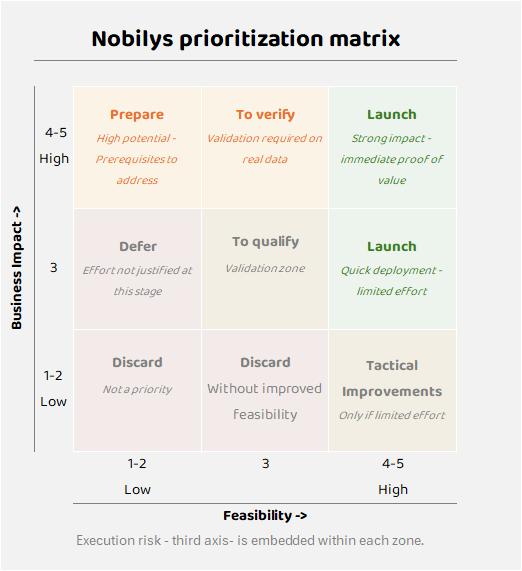
Each use case is evaluated in a working session against the three dimensions of the framework.
The first is expected value, linked to observable outcomes - margin, cost, inventory, service levels or avoided losses - and weighted by the frequency of the problem. A precise prediction applied to a rare event, or one on which no action can be taken, may be worth less than an imperfect model applied to a frequent and economically material decision.
The second is feasibility. This is not the availability of the technology, which in most cases already exists. It is the availability of the conditions required to use it: accessible and usable data, relevant skills and the ability to integrate the solution into the existing process.
The third is execution risk: the number of functions involved, the degree of process change required, user acceptance, clarity of business ownership and the ability to move from pilot to deployment.
Two initiatives with comparable expected impact can have very different probabilities of success.
This third dimension is what separates a workshop matrix from a genuine decision-support tool.
Verify and conclude
A matrix developed in a meeting room remains a representation of the organisation’s assumptions.
For the best-positioned initiatives, the data itself must be tested: sample extracts, actual historical records, missing-data rates, consistency of definitions and the frequency of the events to be predicted.
This confrontation corrects false assumptions in both directions.
An initiative considered straightforward may prove unrealistic because the historical record is inadequate. Another, initially viewed as difficult, may turn out to be feasible because the data is already well structured.
This is what produces the final matrix and converts a strategic discussion into a documented investment decision.
Management receives the roadmap - and decides.
Launch, prepare, defer, discard
At the end of the process, each initiative receives a clear decision.
Launch
The expected impact is sufficient, feasibility has been confirmed on actual data and the execution risk is manageable.
The initiative enters a proof-of-value phase, with stopping criteria defined before the first euro is committed.
Prepare
The potential is high, but a prerequisite is missing - data quality, historical depth, process stability or clear accountability.
The immediate priority is to address those conditions, not to build the model.
Defer
The case is relevant, but not yet a priority given the organisation’s resources or level of maturity.
Deferral is an explicit, dated and reasoned decision.
Discard
The expected impact is too low, the risk is disproportionate or a simpler solution exists.
Traditional automation, a process change or the decision not to intervene may sometimes create more value, faster and with less risk.
A credible strategy must be able to conclude that AI is not the right answer - and identify what is.
The last two decisions are the least popular and often the most value-creating.
They release resources, business attention and executive support for the small number of initiatives capable of producing credible evidence.
Launching too many pilots disperses all three.
A successful pilot is not one that produces an impressive demonstration. It is one that enables management to decide, with sufficient evidence, whether to stop, correct, continue or deploy.
The business owns the outcome
For every selected initiative, a business owner must be accountable for the economic outcome - not only for project delivery.
The data team may develop the model. IT may secure the infrastructure. A supplier may deliver the solution.
But unless the business owns the improved decision and the value created, AI will remain peripheral, regardless of its technical quality.
Conclusion
An artificial intelligence strategy should not be measured by the number of ideas collected, pilots launched or licences purchased.
It should be measured by the quality of the choices it enables - including the choice to stop.
At the end of the process, the company should not have another narrative about AI.
It should have a prioritised portfolio, identified owners, explicit prerequisites and a clear sequence of action.
It should have a plan.
Christian Cirino - Nobilys Group